

+86-0519-85282061
Current path: Home > Products&Service > Project Implementation > Machine Vision
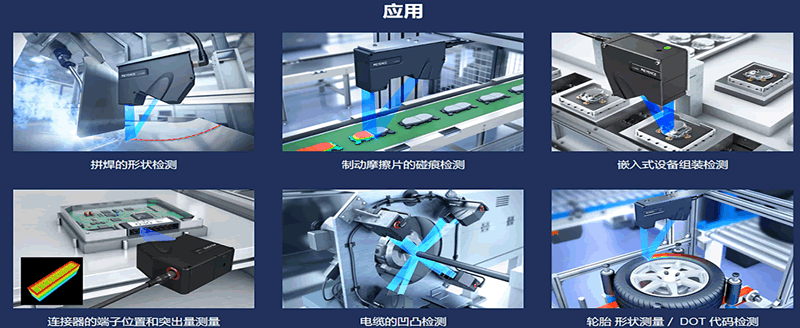
Based on Mentechs's years of experience in visual inspection applications, it can detect various product defects, such as surface scratches, surface stains, surface dents, broken welds, and damage.
Principle of the German Micro-Epsilon Laser Profiler
German Micro-Epsilon laser profile scanners utilize the laser triangulation principle to perform 2D profile scanning on the surfaces of different measured objects. A laser beam is expanded by a set of specific lenses to form a static laser line, which is projected onto the surface of the measured object. A high - quality optical system projects the diffused reflected light of this laser line onto the photosensitive matrix of a highly sensitive sensor. Besides the distance information (Z - axis) from the sensor to the measured object, the controller can also calculate the position along the laser line (X - axis) by using this set of images. The sensor finally outputs a set of 2D coordinate values, and the origin of the coordinate system is relatively fixed with respect to the sensor itself. By moving the measured object or the sensor, 3D measurement results can be obtained.
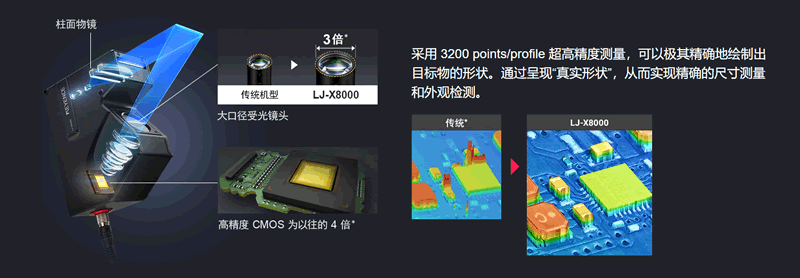
A laser beam emitted by a laser diode forms a point-like light spot on the surface of the object being measured. A special lens group is used to spread the laser point into a line. Traditional beam-splitting laser sensors use cylindrical lenses to refract the laser. The major drawback of this conventional approach lies in the extremely weak edge illumination caused by the Gaussian intensity distribution along the laser line. The scanCONTROL profile sensors provided by German Micro-Epsilon, however, utilize precision wedge-shaped lenses, which effectively eliminate the issue of reduced light intensity at the edges of the laser line.
Reflected Light
During measurement, the highly sensitive CMOS sensor matrix captures the light reflected from the object's surface, forming a high-precision contour image. Any change in the object's profile alters the shape of the laser line projected onto its surface, thereby modifying the image captured by the sensor matrix. By moving either the probe or the object, multiple scan line profiles are obtained. Combining these profiles generates a 3D image, also known as a "point cloud" because it consists of thousands of independently measured points.
Comprehensive Considerations
The additional measurement dimension makes profile scanner sensors more complex than other types of displacement sensors. In principle, it is not possible to simply determine whether an object can be measured by a profile scanner. Successful measurement often depends on which measurement values need to be obtained and the environment in which the measurement is performed. Therefore, the feasibility of measurement requires a case-by-case evaluation of each object from scratch.
For example, measurement success depends on the available measurement time. The slower the object passes through the probe beam, the more time can be allocated for measurement. Thus, the feasibility of a static measurement does not necessarily imply the feasibility of a dynamic measurement.
The measurement results also depend on the reflective properties of the object's surface. Specifically, the intensity of reflection or absorption will determine whether a valid signal can be obtained. The material itself can affect the results as well. For instance, if a translucent object is overly transparent, the measurement signal may become completely distorted.
Finally, contour defects of the object, contours that may generate shadows, and surfaces prone to multiple reflections should be considered. All of these fundamental factors can significantly impact the quality of the measurement signal and the accuracy of the results.
Proper Configuration
Beyond the factors mentioned above, a continuous signal reflected from a clearly identifiable contour surface may still be defective and unusable. To avoid this, every individual parameter of the profilometer must be correctly configured to suit the object being measured. Employing appropriate filters and setting optimal exposure times can often improve poor signals, and successful testing is achieved through iterative adjustments.
For example, when measuring a rapidly moving black rubber object, both a short exposure time and the object's high light absorption can easily lead to inaccurate results. Conversely, if the black object is stationary or moving slowly, a longer exposure time may be conducive to capturing complete contour information.